Graduate Student Applications Now Open for Fall 2027
The REACH Lab is actively recruiting Ph.D. students for the Fall 2027 cohort through the USC Department of Psychology Clinical-Community Psychology program. We are especially interested in applicants with backgrounds or interests in cognitive aging, health equity, PTSD and adversity, digital cognitive assessment, or neuropsychological disparities. We strongly encourage applications from scholars from backgrounds historically underrepresented in psychology and neuropsychology.
Prospective students are encouraged to email Dr. Prieto before applying with a brief introduction, your CV, and a note about your research interests and how they align with the lab's work.
Join the Lab →REACH Lab Launches at the University of South Carolina
Dr. Sarah Prieto joins the USC Department of Psychology as Assistant Professor and Clinical Neuropsychologist at the USC Brain Health Center. The REACH Lab (Research on Equity, Adversity, and Cognitive Health) officially opens its doors in Columbia, South Carolina. The lab focuses on the intersection of social determinants of health, cognitive aging, and neuropsychological equity, with current NIH-funded work examining how SDOH influence Alzheimer's disease biomarker accumulation and access to cognitive healthcare.
About the Lab →Dr. Prieto Receives Post-Doc Fellow Research Award from the International Neuropsychological Society
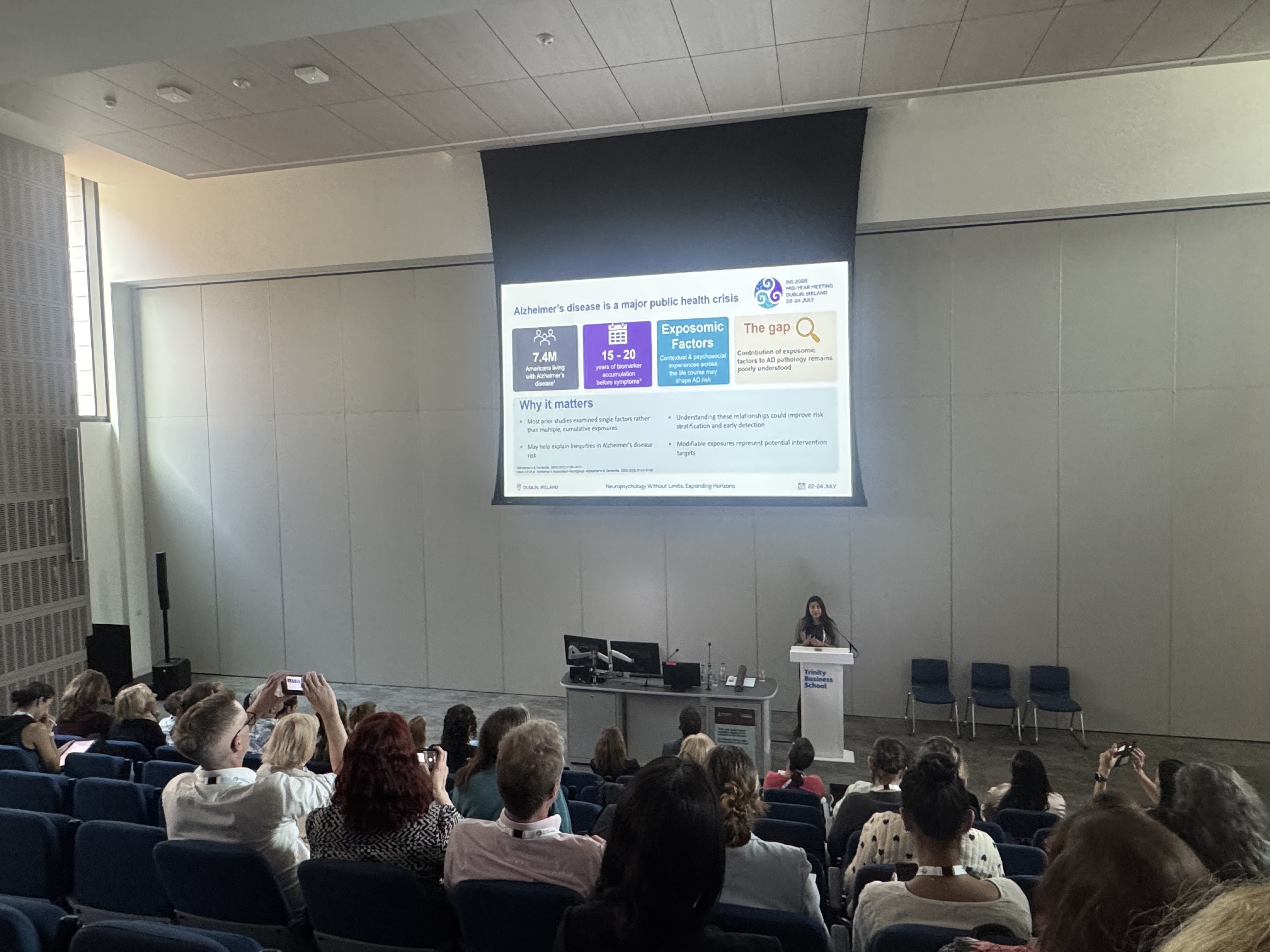
Dr. Prieto delivering an oral presentation on exposomic factors and amyloid pathology at the INS Mid-Year Meeting, Dublin, Ireland, July 2026.
Dr. Prieto has been honored with the 2026 Post-Doc Fellow Research Award from the International Neuropsychological Society (INS), awarded in recognition of outstanding scientific contributions to the field of neuropsychology at the postdoctoral level. The award reflects her program of research examining how stress, adversity, and social context shape cognitive aging and dementia risk, with an emphasis on making neuropsychological services more equitable and accessible.
During her fellowship at Butler Hospital and Warren Alpert Medical School of Brown University, Dr. Prieto secured a two-year National Institute on Aging subaward investigating psychosocial and environmental factors related to Alzheimer's disease risk and healthcare accessibility, was selected for the Alzheimer's Association Summer Research Institute, and serves as an Editorial Fellow for Neuropsychology.
Read the Full Story →Editorial Fellow, Neuropsychology (APA)
Dr. Prieto has been selected as an Editorial Fellow for Neuropsychology, an American Psychological Association journal dedicated to basic and applied research in neuropsychology. The fellowship provides an immersive look into the peer-review and editorial decision-making process, supporting the next generation of neuropsychology scholars in shaping the field's scientific literature.
New Publication in Epilepsy & Behavior
Dr. Prieto and colleagues have published "Toward a Multimodal Model of Internalized Epilepsy Stigma" in Epilepsy & Behavior (Vol. 174, 110812). The paper proposes an integrative framework linking identity, perceived stigma, internalization processes, and downstream health outcomes, drawing on theoretical models from the stigma and health disparities literature. This work advances our understanding of how stigma becomes embodied and how intervention programs can be better targeted.
View Publication →Advancing Neuropsychology: Insights from 102 Brain-Behavior Experts
Dr. Prieto and colleagues' expanded study, "Advancing neuropsychology: Insights and advice from a qualitative analysis of 102 brain-behavior experts," has been published in Neuropsychology. Building on the team's earlier 94-expert analysis, this updated qualitative synthesis broadens the consensus on priorities for training, equity, access, and innovation across the field.
View Publication →Subjective and Objective Cognition with Mood in Parkinson's Disease
Dr. Prieto co-authored "Relationships among subjective and objective cognition with mood in treatment-naïve people with Parkinson's disease," published in Neuropsychology with Varela, Margolis, Akbar, and Davis. The study examines how subjective cognitive complaints and objective performance relate to mood symptoms in newly diagnosed, treatment-naïve patients with Parkinson's disease.
View Publication →Advancing Neuropsychology: Insights from 94 Brain-Behavior Experts
Dr. Prieto and colleagues published "Advancing neuropsychology: Insights and recommendations from qualitative content analysis of 94 brain-behavior experts" in The Clinical Neuropsychologist. This consensus-building study synthesizes expert perspectives on the state of the field, identifying critical priorities for training, equity, access, and innovation in neuropsychological practice.
View Publication →Stigma Intersectionality and Epilepsy Self-Management Programs
"Effects of stigma intersectionality on an epilepsy stigma self-management program" published in Epilepsy & Behavior (Vol. 172). This paper examines how multiple intersecting stigmatized identities moderate response to stigma self-management interventions, with implications for tailoring programs to community-specific needs.
View Publication →Poster Award — INS Epilepsy Special Interest Group
Dr. Prieto received a Poster Award from the International Neuropsychological Society (INS) Epilepsy Special Interest Group. The award recognized research presented at the INS Annual Meeting, highlighting the lab's contributions to understanding stigma, self-management, and neuropsychological outcomes in epilepsy populations.
View Related Publications →Media, Community Talks & Science Communication
The REACH Lab is committed to communicating science beyond the journal. As the lab establishes, we will post media appearances, community talks, podcast features, and other public-facing science communication work here. If you are interested in having Dr. Prieto speak at a community event, clinic, or organization, please reach out.
Contact Us →